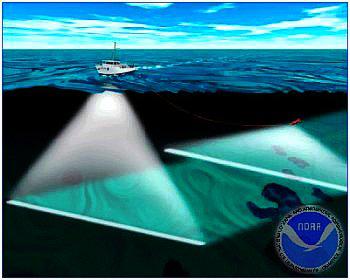


About Sonar Waves
Sound behaves differently in water compared to air. It travels five times faster in water than in air. In water, it is also transmitted much farther with much less attenuation than in air. (And LFA sonar maintains its intensity much farther than does mid-range sonar.) LFA sonar will maintain relatively high intensity levels hundreds of miles from the source. For example, a marine mammal scientist working off the Washington coast recorded a loud sound (measured at 140 dB). After investigating, he learned it was produced by Navy LFA sonar exercises conducted off Southern California – a distance of over 900 miles!
Sound penetrates an animal’s body when immersed in water. In air, 99.97% of the acoustic energy is reflected from a body. In water, however, there is no reflection or reduction of energy because the body is mostly water. Essentially all of acoustic energy goes into a body immersed in water. This effect, which is known to cause tissue rupture and hemorrhaging has never been adequately addressed in any of the Navy’s Environmental Statements since there are no known ways to avert this if a marine mammal is present when the sound is emitted. As stated above, the sound has been catalogued to reach areas a far as 900 miles in distance. Since the US Navy’s way of looking for cetaceans in the area is “posting a man or woman lookout on the deck of a ship” it is far from an adequate “safety measure”.